
Journal — The workshop
Zellige: The Beauty of Imperfection
In Fez, a thousand-year-old craft is still passed on by hand, hammer and anvil, one fragment at a time. Its imperfection is precisely what makes it impossible to copy.

There is something deeply calming about a surface that refuses to be perfect. Zellige, the glazed earthenware cut by hand into geometry, has been made in Morocco for a thousand years and has never tried to be uniform. Every piece carries the tremor of a hand, the mood of a kiln, the light of a working day. That irregularity is exactly what we went looking for.
01Fez, the cradle
Zellige took shape around the tenth century, between Morocco and al-Andalus, when craftsmen began cutting fragments of glazed terracotta to compose geometric mosaics. It reached its golden age under the Marinid dynasty, between the thirteenth and fifteenth centuries, when the madrasas and palaces of Fez set the codes we still recognise today.
Fez remains the heart of the craft. Its workshops rely on a pale, fine clay from the surrounding region, worked the same way for generations.

What the eye reads as irregularity is, in fact, the signature of a hand.
A maalem in Fez
02The hand of the maalem
Zellige is never moulded, never printed. It is cut piece by piece by a maalem, a master craftsman whose skill has been handed down almost unchanged. From raw clay to the last fragment set in place, every step stays manual.
- 01
The clay
Local clay is cleaned, soaked and kneaded by hand until smooth and free of air.
- 02
Shaping and firing
Rolled into slabs, cut into raw squares, dried in the sun for several days, then fired a first time.
- 03
Glazing
Each tile is glazed by hand with mineral pigments, then fired again to fix colour and shine.
- 04
Cutting
The maalem cuts each tile with a hammer to free the shape: star, cross, diamond.


In praise of irregularity
In a decoration industry shaped by uniformity, zellige moves the other way. No two pieces are identical: the colour shifts slightly from one tile to the next depending on the kiln, the cut is never perfectly straight, the surface keeps the grain of the hand that shaped it.
These are not flaws to be corrected. They are the proof of an object that was made, not simply produced. It is the spirit Casarin wants to bring into a home: a beauty that does not seek perfection, only the truth of material and gesture.
03A geometry that thinks in infinity
The patterns of zellige are not decorative by chance. In a tradition that avoids depicting living beings in sacred art, geometry becomes a language: endless interlacing and repeating stars suggest an order larger than the eye that looks at them. Laying zellige is never only about dressing a wall. It brings into the house a quiet, thousand-year-old form of contemplation.
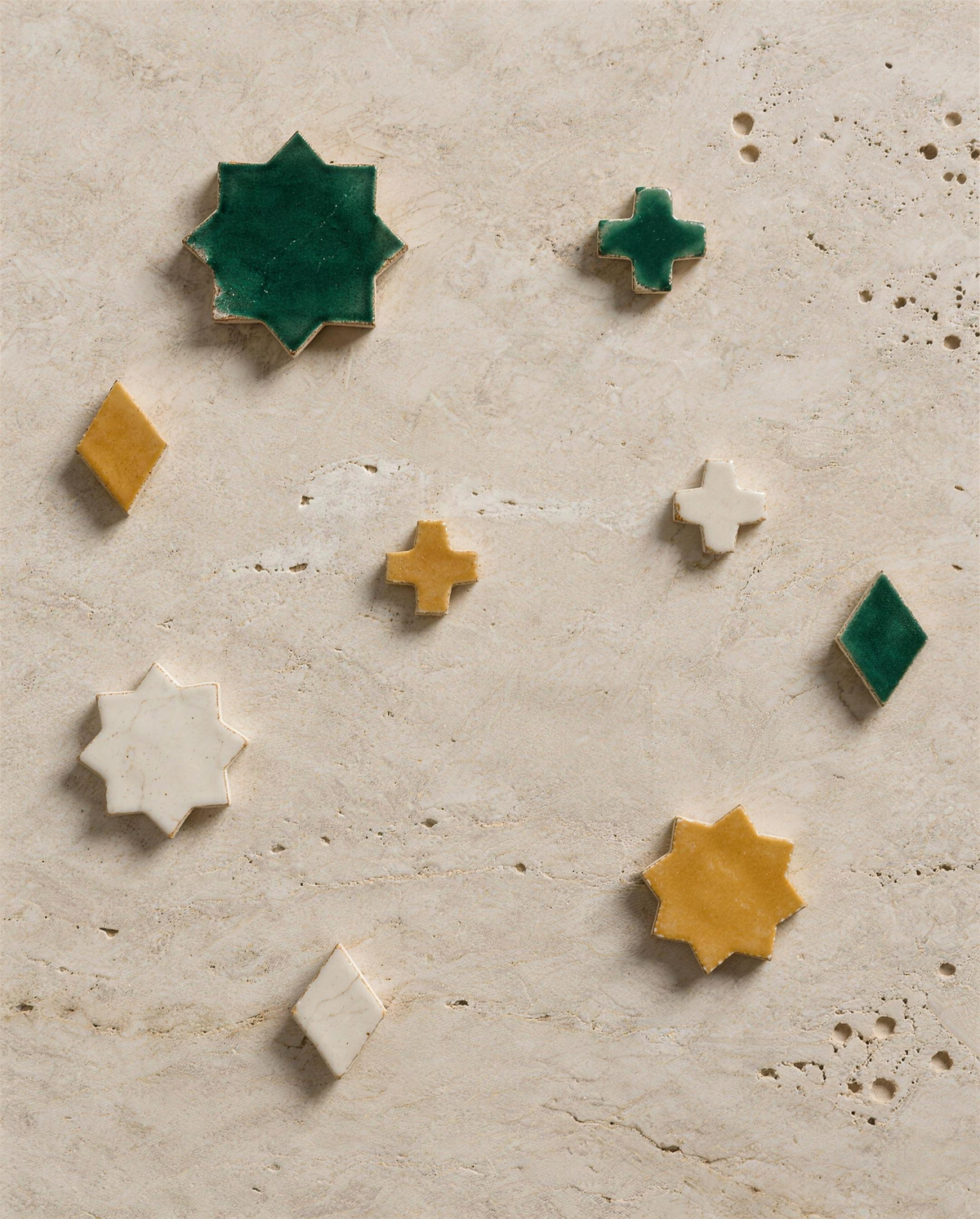
The colours of Fez
- Fez blue#2F5D8A
- Emerald#3C6E52
- Honey#C99A3A
- Ancient white#EDE6D6

Imperfect, and rightly so
Earth, shaped by hand.
Choosing a handmade piece means accepting that no two will ever be quite the same, and finding in that what mass production can never offer: a human trace, intact, in an everyday object.