
Journal — The workshop
Tadelakt: The Plaster That Turns Walls Into Stone
In Marrakech, lime is pressed and polished by hand until it shines like stone and resists water. A centuries-old finish that still has no industrial equivalent.

Some walls look like stone and feel like skin. Tadelakt is a lime plaster from Marrakech, pressed and polished by hand until it becomes smooth, soft to the touch and resistant to water. It has lined hammams and riads for centuries. Today it is also the surface of some of our pieces.
01A plaster from Marrakech
Tadelakt comes from the region around Marrakech, where lime has long been burned in kilns and slaked by hand. Its name is usually traced to a word meaning to rub or to knead, a fair description of how it is made: the material is worked, compressed and polished far longer than any ordinary plaster.
It was first used where water is everywhere: hammams, fountains, basins, the walls of riad courtyards. A surface that could be washed, that would not crack in the heat, and that would only get better with time.
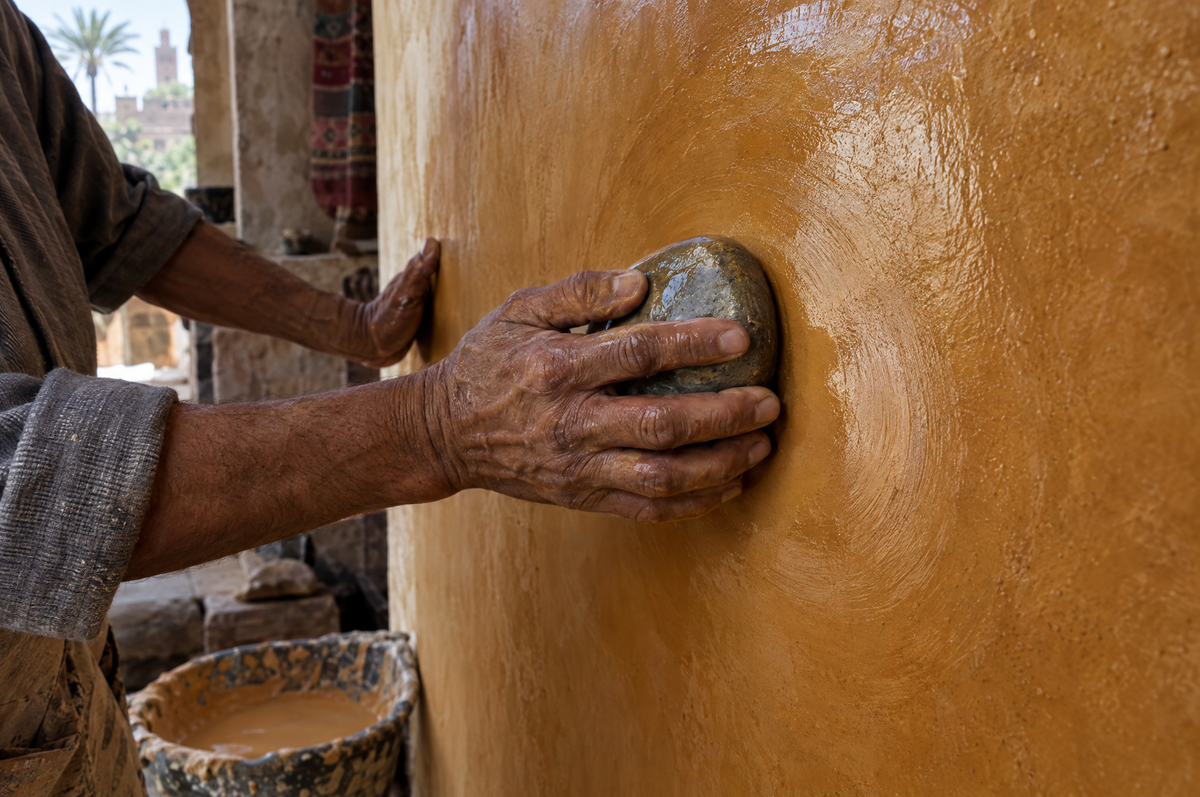
Tadelakt is not applied. It is pressed, again and again, until it agrees to shine.
02Lime, stone and black soap
The recipe is short, and that is the point. Lime, water, sometimes a mineral pigment. Everything else is gesture.
- 01
The lime
Lime is slaked and left to rest until it becomes a dense, workable paste.
- 02
Application
The plaster is laid in several thin coats with a trowel, then pressed while still fresh.
- 03
Polishing
A smooth river stone is rubbed over the surface again and again, closing the pores and raising a soft sheen.
- 04
Black soap
Olive-based black soap is worked into the surface. It reacts with the lime and makes it repel water.
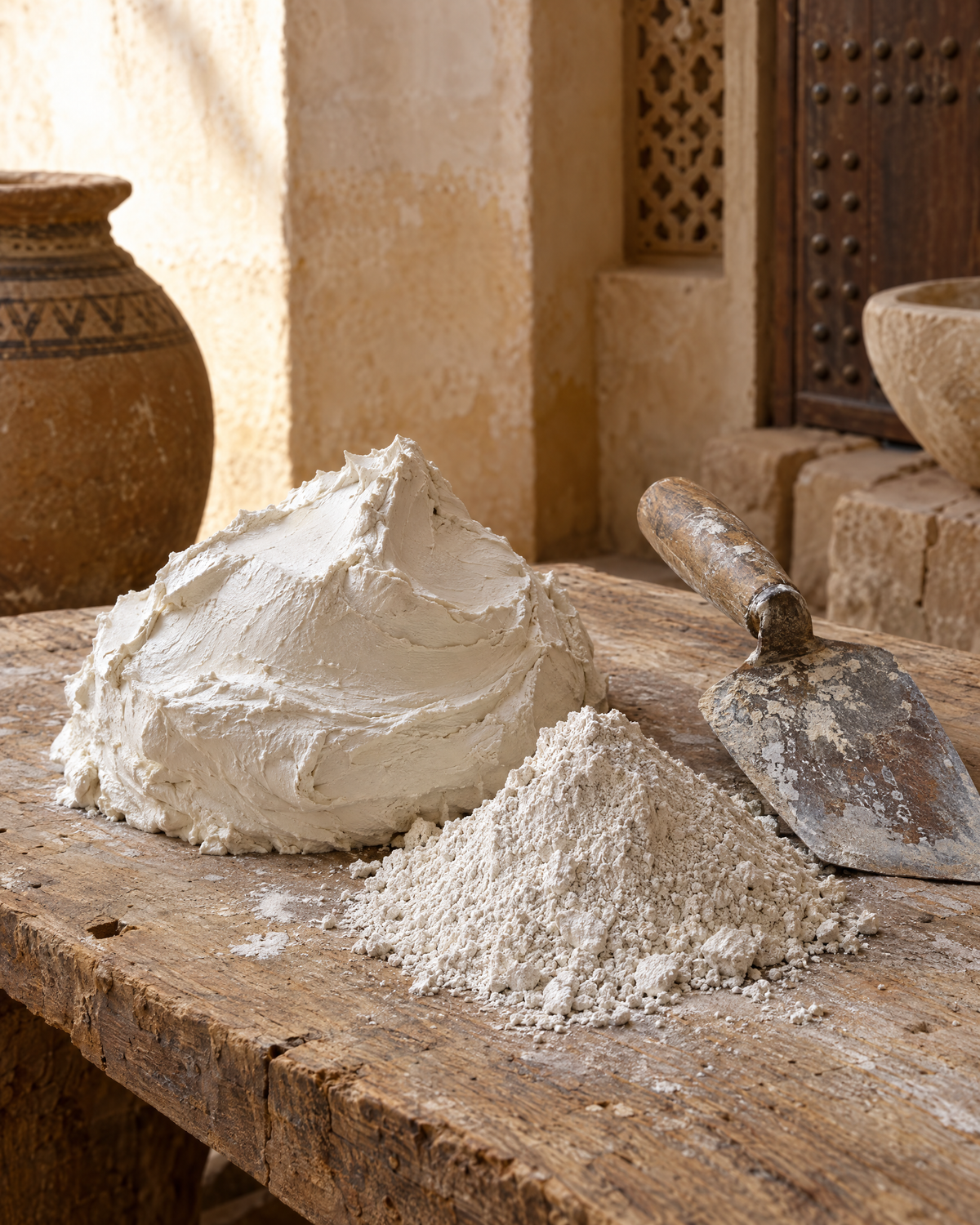

A surface that keeps the hand
No two tadelakt surfaces are the same. The colour clouds slightly, the sheen changes with the light, the marks of the stone stay faintly visible. It is closer to a skin than to a coating.
That is why we use it on objects. On a vessel, tadelakt turns a simple form into something you want to touch: matte from afar, soft and almost warm up close.
03Living with tadelakt
Tadelakt ages well. It is cleaned with a soft cloth and a little water, and can be refreshed from time to time with a thin layer of black soap. Small marks blend into the surface over the years instead of standing out.
It asks for one thing only: to be treated as a natural material, not as plastic. In return it gives a quiet presence that no industrial finish can imitate.

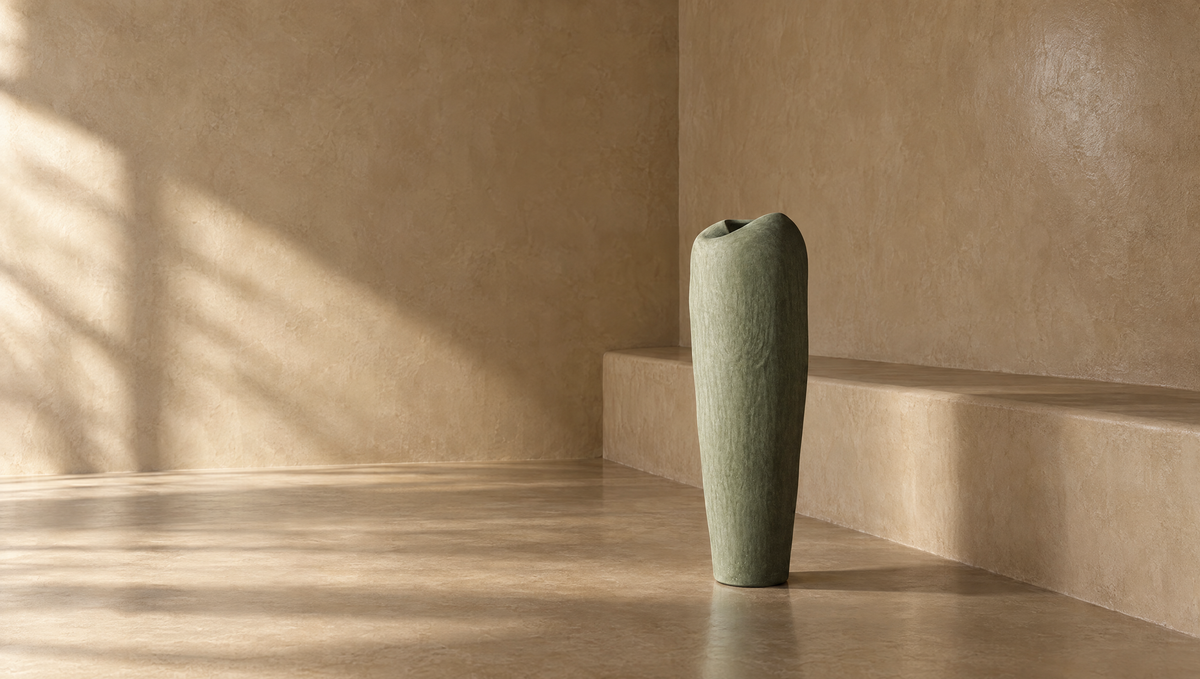
Made slowly
Lime, shaped by hand.
Our tadelakt pieces are made one by one, polished by hand and sealed with black soap. Each one carries its own clouds and its own light.